

Please subscribe to Fox News to access this content
Plus, with your account you get exclusive access to handpicked articles and other premium content for free.
Please enter a valid email address.
By entering your email address and pressing “Continue,” you agree to the Fox News Terms of Use and Privacy Policy, including any financial incentive notices. To access the content, check your email and follow the instructions provided. Having trouble? Click here.
FOX First Report – An Iranian resistance group in exile has uncovered conclusive evidence implicating senior administration officials in directly supporting the Houthis in their attacks on ships in the Red Sea.
Fox News Digital has reviewed evidence provided by the People's Mojahedin Organization of Iran (PMOI/MEK) which it claims shows that Iranian-backed terrorist proxy groups based in northern Yemen are being funded by Tehran. The Houthis have carried out more than 50 attacks targeting ships in the Red Sea and Gulf of Aden since October 7.
The MEK pointed out several methods and locations the Iranian Revolutionary Guard Corps-Quds Force (IRGC-QF) is using to deliver a variety of weapons to the Houthis, including drones, cruise missiles, ballistic missiles, anti-ship mines, radar equipment and communication systems. It noted that some of the missiles in the Houthi arsenal are manufactured by the Aerospace Industries Organization, which is under U.S. Treasury sanctions.
A February 2024 Defense Intelligence Agency (DIA) report supports the group's claims by showing Iran supporting Houthi proxies with a side-by-side comparison of Houthi and Iranian drones and missile systems. Among the ballistic missiles in both countries' arsenals are the Iranian Shahab-3, which the Houthis call “Toofan.”
Biden administration's sanctions waivers would give Iran access to billions of dollars to continue its war efforts, experts say
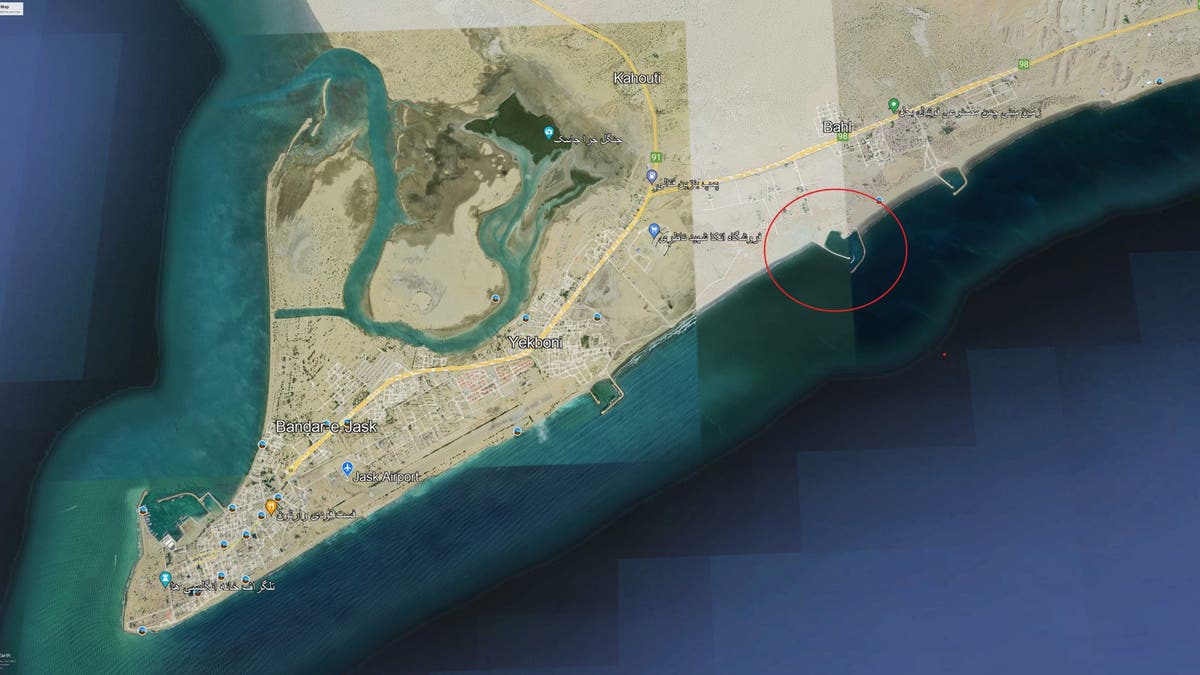
The IRGC-QF uses the port east of Yask city to send military supplies to the Houthis in Yemen. (People's Mojahedin Organization of Iran – PMOI/MEK)
The Houthi arsenal also includes Iranian missiles that have been used to attack Israel. The Defense Intelligence Agency report also showed remains of what appears to be a Pave land-attack cruise missile, which the Houthis have dubbed the “Quds 4.” The missile was “fired by the Houthis toward Israel in late October 2023,” according to the Defense Intelligence Agency.
Following the October 7 terror attack by Hamas, the Houthis attempted their first direct attack on Israel on October 19, according to the Combating Terrorism Center at West Point. On March 18, the Israel Defense Forces reportedly confirmed that a Houthi cruise missile had entered Israel and landed near Eilat.
The IDF did not respond to a request for comment on how many times the Houthis have attempted attacks on Israel since October 7, or whether they have used Iranian weapons in the attacks.
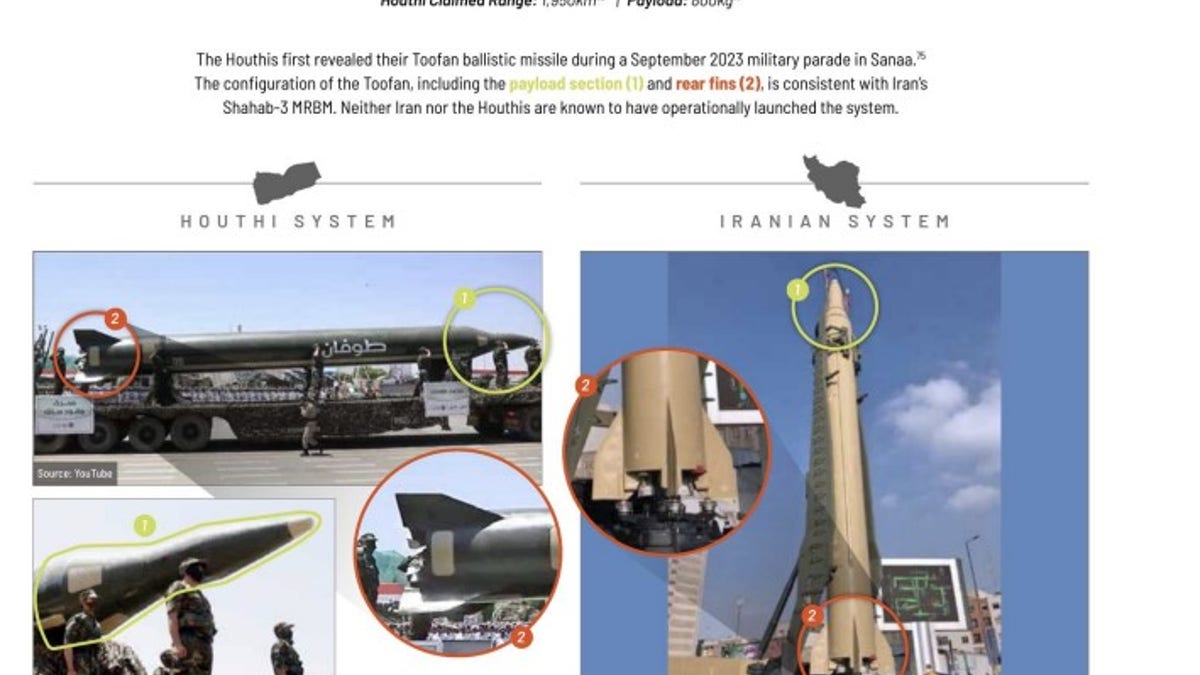
An Iranian ballistic missile, the Shahab-3, manufactured by the sanctioned Aerospace Industries Organization, is stored in a Houthi arsenal under the name “Toufan.” (Defense Intelligence Agency)
Behnam Ben Talebr, a senior fellow at the Foundation for Defense of Democracies, told Fox News Digital that although the Houthis are “the newest members of the Axis of Resistance,” they “in fact have the most advanced long-range capabilities of any of the Islamic Republic of Iran's proxies to date.” “Equipping a force like the Houthis with capabilities like medium-range ballistic missiles and anti-ship ballistic missiles says something about the future operations Iran envisions for this force,” Talebr added.
The Houthis' recent radicalization led the U.S. Treasury Department to again designate the group as a Specially Designated Terrorist Group in February 2024. The designation was revoked in February 2021.
Secret Iranian drone base used by IRGC, rebel groups expose terrorist proxy
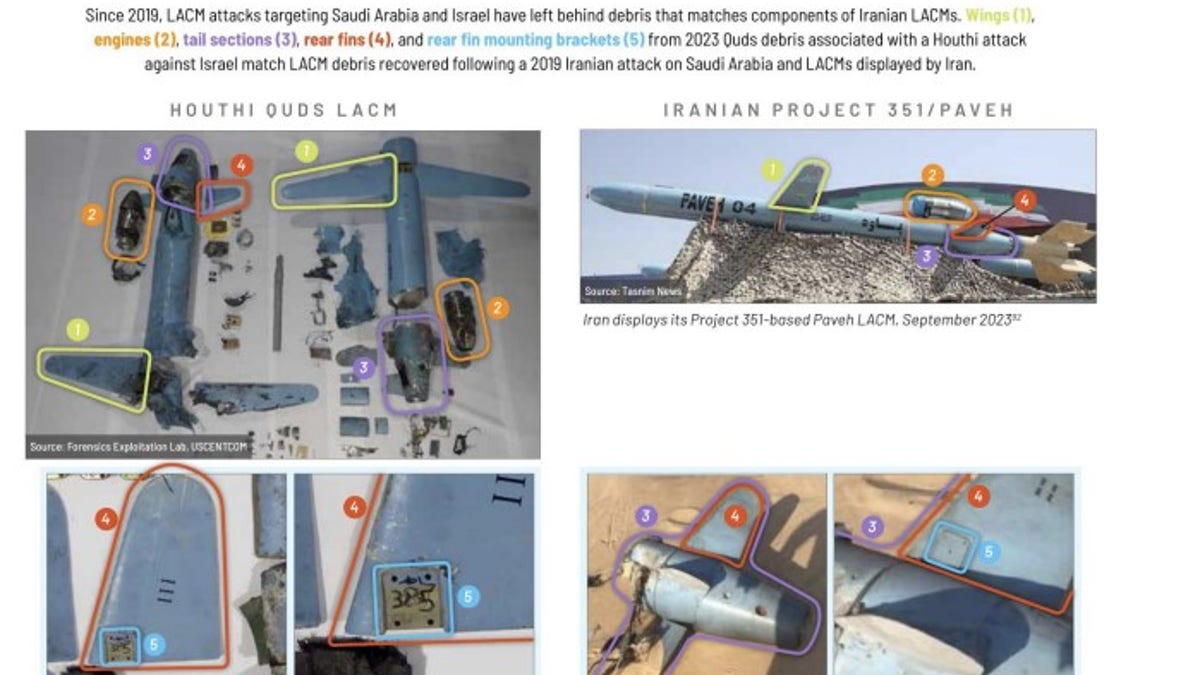
The Defense Intelligence Agency shows remnants (left) of a Quds-4 land-attack cruise missile believed to have been fired by the Houthis toward Israel in October 2023. (Defense Intelligence Agency)
In a report to Fox News Digital, the MEK outlined the methods the IRGC-QF uses to transport military supplies to Yemen. According to the MEK, the IRGC “pressured several local barge owners” to transport weapons to Houthi ships “10 miles off the coast of Yemen.” On other occasions, the MEK reported that Iran sometimes transports supplies to Yemen “after stopping in African countries.”
The report said Iran sometimes hides weapons in fenders, “large shock absorbers” that prevent ships from hitting piers or other obstacles. The fenders are sometimes moored below the waterline in predetermined locations and “can be picked up by another vessel using its built-in GPS,” the MEK reported.
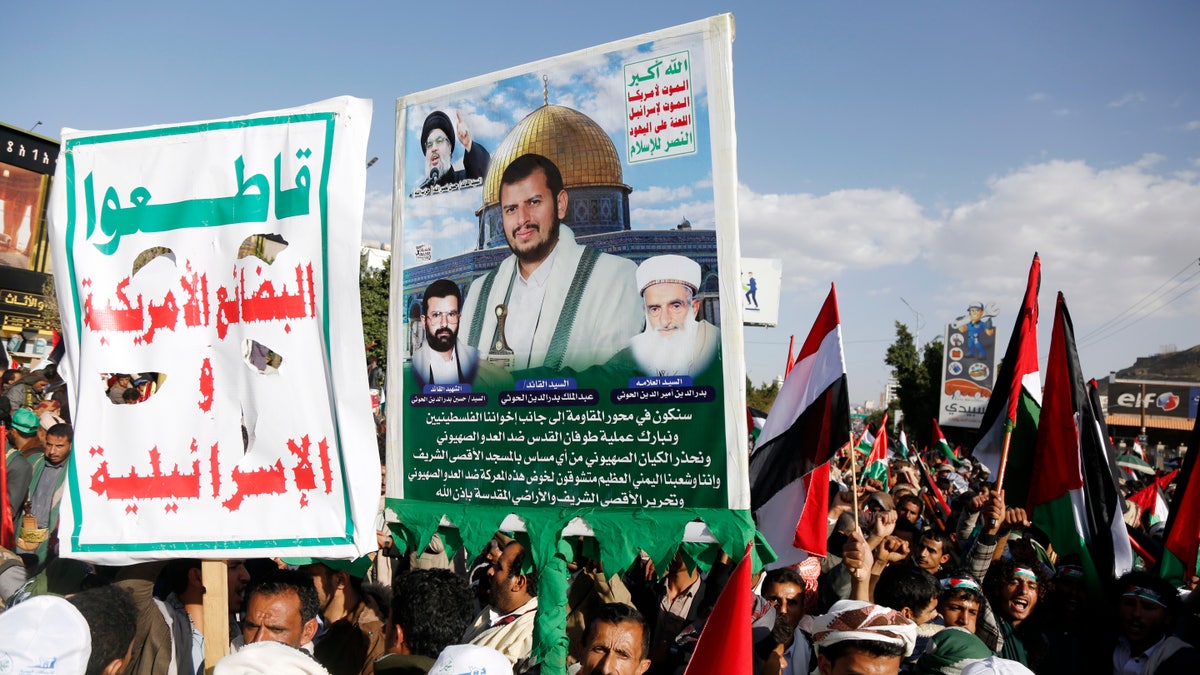
Demonstrators protest against Israeli airstrikes on the Gaza Strip in Sana'a, Yemen, on October 20, 2023. (Mohamed Hammoud/Getty Images)
Fenders have also been attached to Iranian barge ships. On August 13, 2019, the MEK said that “fenders measuring up to six meters in length were attached to the ship at Bushehr quay two days before it set sail for Laban Island in the Persian Gulf.” “Military weapons and equipment were hidden inside these fenders,” the MEK said, but the group did not have information about the cargo's final destination.
Yemen's Houthi rebels reportedly possess hypersonic missiles

The MEK says the IRGC is stuffing small arms intended for the Houthis into the fenders protecting their barges. (People's Mojahedin Organization of Iran – PMOI/MEK)
On May 27, 2020, the MEK said Yemenis had launched a barge “loaded with light weapons” from a location two miles from the port city of Yask. It also noted that Bahman Pier, “one of about 80 or 90” secret ports built on the Persian Gulf and Sea of Oman coasts in 1982 on the orders of Iran's Supreme Leader Ayatollah Khomeini, remains “beyond the supervision of international organizations.” The MEK said Bahman Pier is used as a means to smuggle oil and petrochemical products and ship weapons to proxies, including the Houthis.
The MEK explained that Iran has not only provided the Houthis with weapons, but also trained them in the use of high-tech weaponry and trained Houthi soldiers, “helping the Houthis evolve from a ragtag group into a conventional army.”
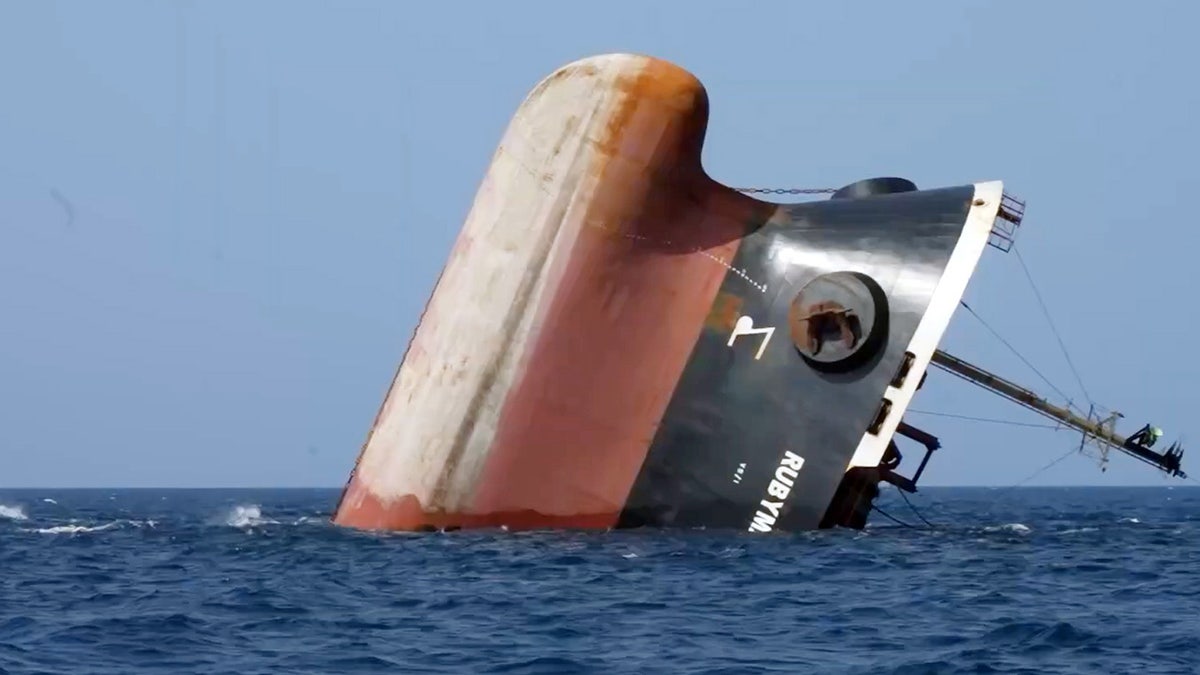
The British-flagged cargo ship Ruby Mar sinks after being attacked by Yemen's Houthi rebels in international waters of the Red Sea on March 7, 2024. (Al Jumhouria Channel via Getty Images)
In a February interview with CBS, Navy Vice Admiral Brad Cooper, deputy commander of U.S. Central Command, confirmed that IRGC members are “operating side by side” with the Houthis in Yemen, “providing them advice and providing them targeting information.”
In addition to training, Talebr also sees signs that Yemen “has become a testing ground for Iranian weapons,” pointing to the Houthis demonstrating a medium-range ballistic missile with a monolithic conical warhead in Yemen several months before Iran “brought it into its arsenal.”
The difficulty of preventing support for the Houthis is also evident in the hierarchy of Iranian leadership involved in maintaining Iran-Houthi relations. According to the MEK, a senior IRGC-QF commander, Brigadier General Abdul Reza Shahrai, alias “Haj Yusuf,” is tasked with overseeing coordination with the Houthis. Assisting him are Brigadier General Ismail Qani, Brigadier General Mohammed Reza Farahzadeh, alias “Abu Bagher,” and Abu Fatemeh.
The MEK also states that its headquarters within Iran's Foreign Ministry “verifies and analyzes the impact of Houthi attacks” and that IRGC Major General Gholam Ali Rashid, commander of the Khatam al-Anbiya Command, is “primarily responsible for military issues in Yemen.” The MEK also claims that Iran's National Security Council sets guidelines for intervention and escalation in Yemen, and that Supreme Leader Ali Khamenei is ultimately responsible for finalizing and approving decisions regarding Yemen's political and military affairs.
Possible Yemeni Houthi rebel missile attack damages ship in Red Sea
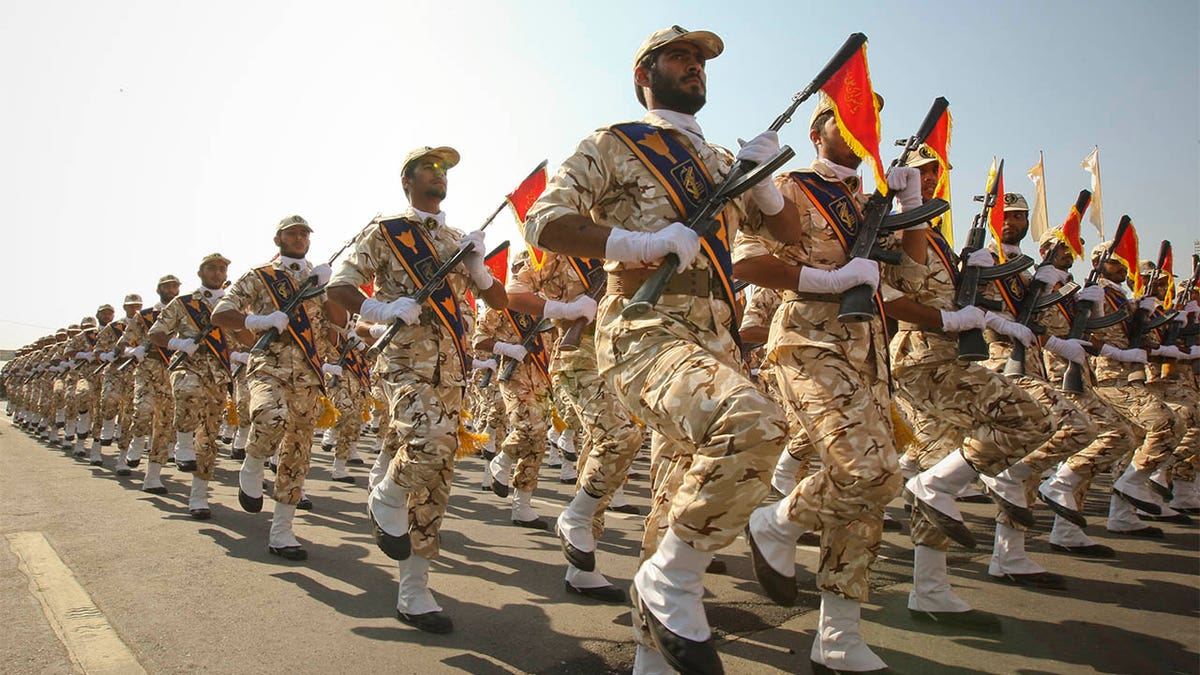
Members of the Iranian Revolutionary Guards march in a parade marking the anniversary of the Iran-Iraq War (Reuters)
Khamenei, Shahrai, Qani, Farazadeh and Rashid are all under sanctions from the U.S. Treasury Department's Office of Foreign Assets Control. The Department of Justice has offered a $15 million bounty for information provided about Shahrai for his involvement in plots to assassinate the Saudi ambassador in Washington, DC, and attack Iraq in which five U.S. soldiers were killed and three wounded.
The U.S. Treasury Department's sanctions against Iran have been strengthened over the years in recognition of Iran's role in financing terrorism in the Middle East. In April, Treasury Secretary Janet Yellen explained that the department was “targeting more than 600 individuals and entities involved in Iranian terrorist activities, human rights violations, and funding of Hamas, the Houthis, Khizoalla, and Iraqi militia groups.”
Though necessary, blocking Iranian financing will be a difficult endeavor. According to Taleb, the Islamic Republic of Iran has a well-established system with the ability to “scale up its material support over time.” Through a combination of direct fund transfers, money laundering schemes, illicit proceeds, and a non-traditional remittance system using front companies and currency exchanges across multiple countries, “Iran has the capacity to fund terrorism and conduct illicit financial transactions throughout the region, even under sanctions.”
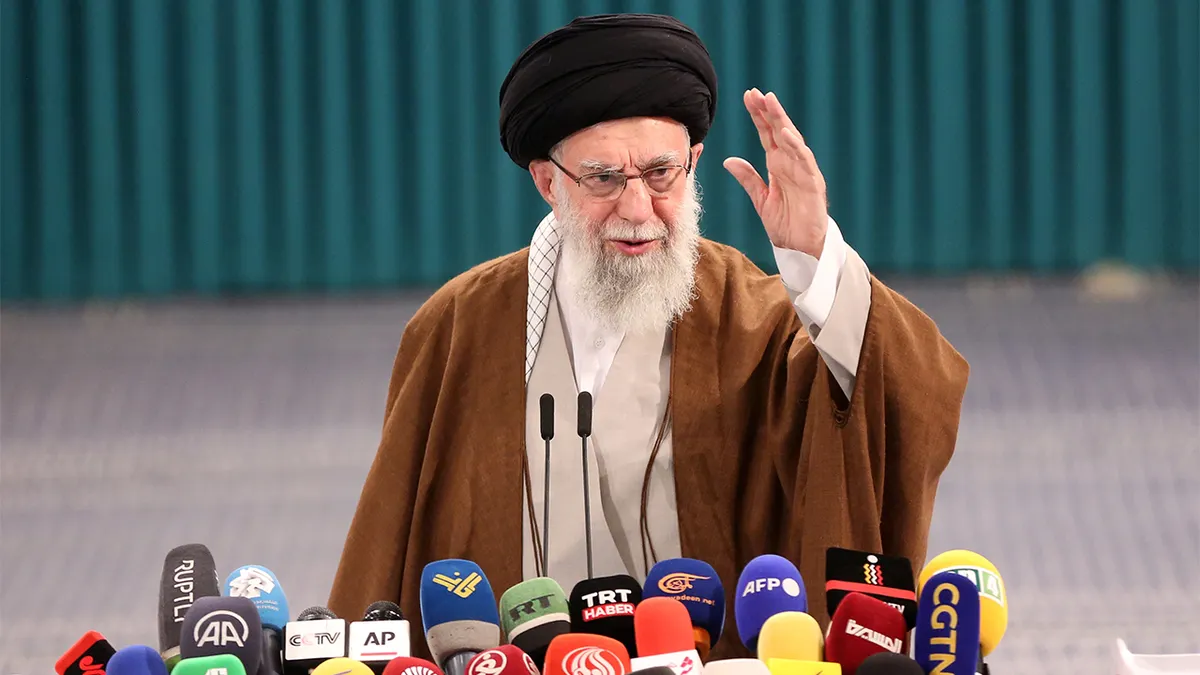
Iran's Supreme Leader Ayatollah Ali Khamenei addresses the media in Tehran on May 10, 2024. (Fatemeh Bahrami/Anadolu via Getty Images)
Ali Safavi, of the Paris-based NCRI Foreign Affairs Committee, called on the international community to “hold the IRGC-QF accountable for using the Houthis to destabilize the region.” Safavi told Fox News Digital that designating the IRGC as a terrorist organization, as the U.S. did in 2019, “would not only severely impede the IRGC's ability to use front companies to evade sanctions and fund its malign activities and proxies, but also seriously hinder its operations in Western countries.” Most importantly, Safavi said, “it would send a strong message to the Iranian people that the main force that put down their uprising is now globally recognized as a terrorist organization, thereby legitimizing their resistance.”
Click here to get the FOX News app
Taleblu said Iran's relationship with the Houthis is key to their strategy to harm Israel. The proxy “creates a new vector of pressure on Israel, forcing it to further expand its multi-layered air and missile defense assets to protect itself.” Ultimately, the resulting financial and military pressure “reduces the political space in which Israel can freely, cheaply, or easily achieve its military objectives and the destruction of Hamas.” Taleblu also said this ultimately “creates the political conditions for greater distance between the United States and Israel.”
Taleblu said Iran knows its “strategy is working” and that the world is “likely to see more weapons proliferation in the region, not less.”
The Associated Press contributed to this report.