

February 2, 2024• Physics 17, 21
Network theory models tested on the works of Johann Sebastian Bach provide tools to quantify the amount of information delivered to listeners by a piece of music.

APS/Karyn Kane
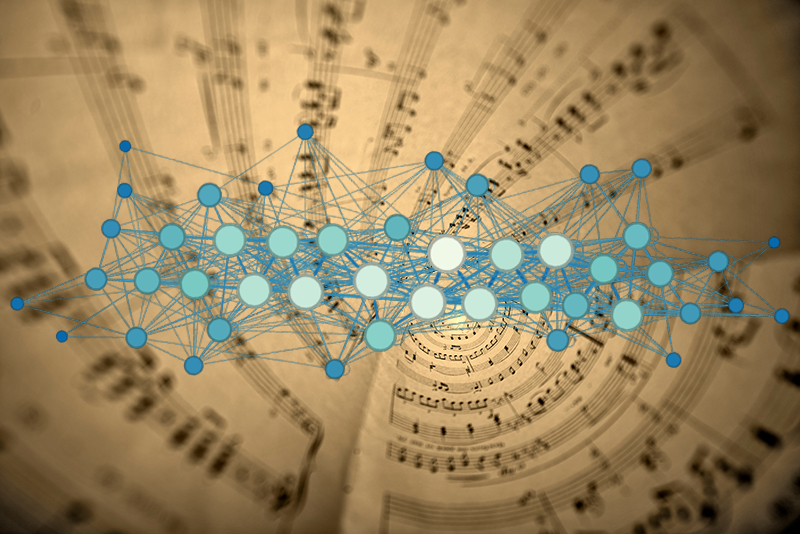
Music is characterized by network-like connections between notes.
APS/Karyn Kane
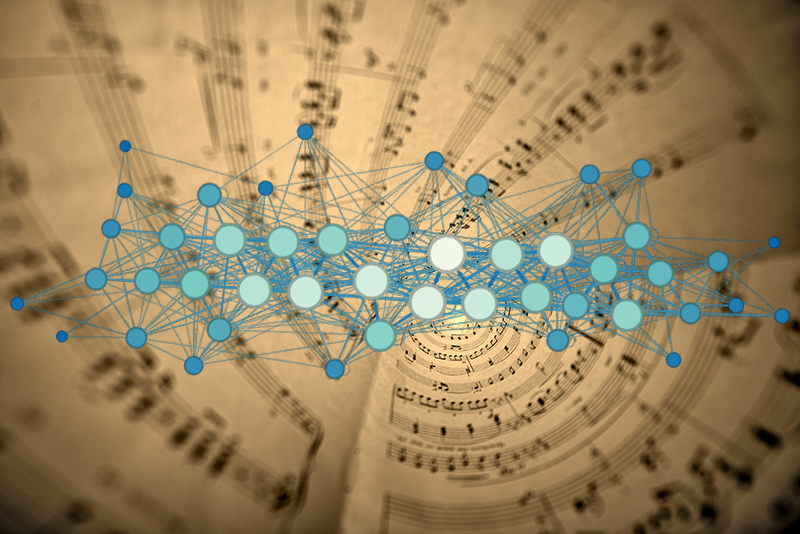
Music is characterized by network-like connections between notes. ×
Great music takes the audience on an emotional journey and tells a story through melody, harmony, and rhythm. But can the information contained in a work, or the effectiveness of a work in conveying it, be quantified? Researchers at the University of Pennsylvania have developed a framework for performing these quantitative assessments, based on network theory. Did. After analyzing a large number of works by Johann Sebastian Bach, we found that this framework can be used to classify different types of musical pieces based on their information content. [1]. This analysis also allowed us to pinpoint specific features of musical works that facilitate the transmission of information to listeners. Researchers say this framework could lead to new tools for quantitative analysis of music and other forms of art.
To tackle complex systems such as musical compositions, the team turned to network theory. Network theory provides powerful tools for understanding the behavior of discrete, interconnected units, such as individuals or power grid nodes, during a pandemic. Researchers have previously attempted to analyze connections between notes using network theory tools. However, most of these studies ignore an important aspect of communication: the flawed nature of cognition. “Humans are imperfect learners,” said Suman Kulkarni, who led the study. The model developed by the team incorporates this aspect through the description of a fuzzy process in which the listener derives an “estimated” network of notes from the “true” network of the original work.
The researchers focused on Bach's works, analyzing hundreds of preludes, fugues, chorales, toccatas, concertos, suites, and cantatas. Kulkarni says Bach seemed like an ideal starting point for this analysis because his works have a highly mathematical structure. Additionally, she says, Bach's prolific output allows for comparisons between vastly different compositional forms.
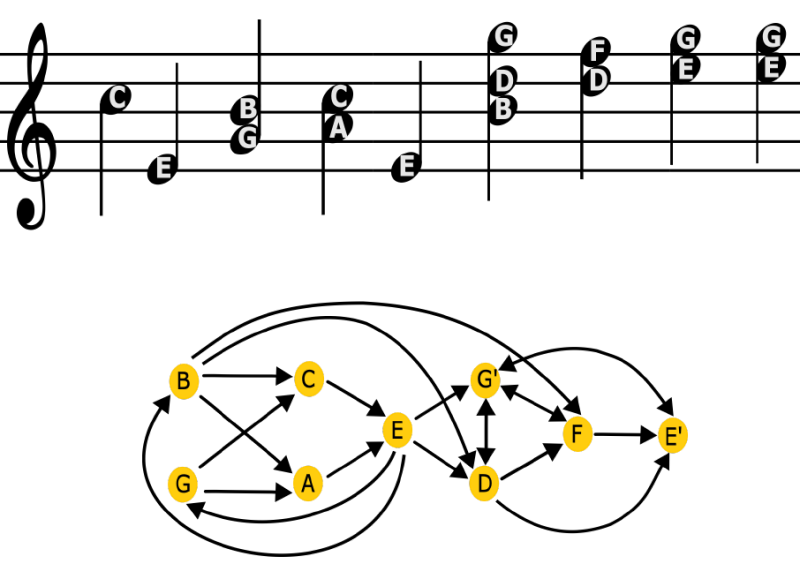
In the network representation of music used by Kulkarni et al., musical notes are represented by nodes, and transitions between notes are represented by directed edges that connect the nodes.
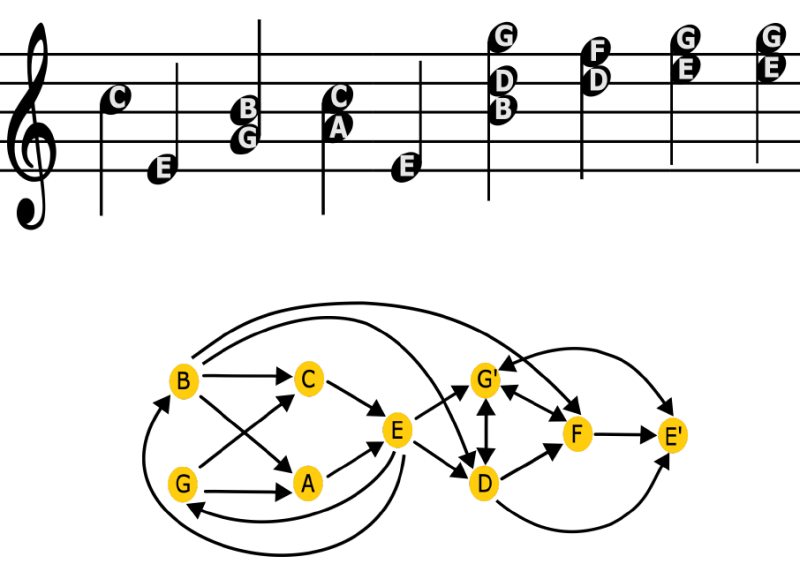
In the network representation of music used by Kulkarni et al., musical notes are represented by nodes, and transitions between notes are represented by directed edges that connect the nodes.
To build a simplified network representation of each Bach piece, the researchers assigned a node to each note, connecting each note to the other through directed edges representing the transition from the subsequently played note. Connected to node. Edges were then assigned different “weights” or thicknesses depending on how often the corresponding note transition occurred within the piece. For each network derived from a fragment, we quantified the amount of information in the network by calculating Shannon entropy, a metric from information theory.
This procedure allowed researchers to compare different compositional forms and showed that they could be distinguished based on entropy or information content. For example, the chorale had the lowest entropy, while the toccata and prelude had the highest entropy. Kulkarni says these differences likely reflect the function of each form. Chorales, meditative hymns intended to be sung by church groups, are simple pieces, and their predictability means they contain little information, but the Toccata and Prelude entertain and surprise. Its complexity conveys a wealth of information. By examining the entropy of the fragments, the researchers found that fragments belonging to the same composition form were clearly grouped into clusters with similar entropy.
After building the true network of the analyzed parts, the researchers calculated an estimated network using a model that describes the average process of human perception. In this process, humans seek a trade-off between the accuracy of representing the recognized network accurately enough and the cost of omitting or simplifying details to reduce the computational complexity of information processing. Masu. For Bach's music, the researchers found that the difference between the true network and the estimated network was much smaller than the randomly generated network. This suggests that musical works have characteristics that reduce cognitive discrepancies. The model allowed the authors to pinpoint some of their characteristics, such as certain forms of clustering within the network and the presence of “thick” edges representing frequently repeated note transitions. Ta.
Kulkarni believes the framework needs to be expanded to incorporate more realistic descriptions of musical compositions, including elements such as rhythm, timbre (the unique sound quality of a particular instrument), and counterpoint (the relationship between different melodic lines). It states that there is. The presence of chords. These multifaceted aspects of music can be captured mathematically through so-called multilayer networks, which are often used to model multidimensional real-world networks. She says important directions for further research include sophisticated descriptions of perceptual processes, such as examining variation among individuals and considering factors such as musical training and cultural influences. states.
A more complete representation of music's information content could enable quantitative comparisons between different songs. Kulkarni says such an approach could reveal how a particular composer's music changed over his lifetime, or how compositions evolved across musical traditions. . She also suggests that the quantitative metrics provided by the framework could provide feedback to assist composers in their compositional process. For example, music composition software can display measurements of entropy and allow composers to make edits that either amplify entropy through harmonious and predictable solutions (creating surprise by going against musical expectations) or decrease entropy. can be instructed. Kulkarni points out that similar approaches could be applied to other art forms, such as literature, to analyze their information content and learnability. Progress in these fields depends on interactions between artists, sociologists, musicologists, and neuroscientists, she says. She says, “There are high barriers between disciplines, but complexity science can help break them down.”
–Mateo Rini
Matteo Rini is editor of Physics Magazine.
References
S. Kulkarni et al., “Information content of note transitions in the music of JS Bach,” Phys. Rev. Res. 6, 013136 (2024).
recent articles
The path to making batteries greener
April 24, 2024
For Shirley Meng, the biggest barrier to achieving sustainable batteries is sociological rather than technological, requiring a shift in thinking about how batteries are consumed and disposed of. read more “
physical chemistry
Recruiting electrochemists with professional degrees
April 22, 2024
Paul Kempler runs a master's degree program at the University of Oregon that provides hands-on training in electrochemistry to people who want to enter the field without the need for a five-year Ph.D. . read more “
Read more articles
Source link